People follow rules every single day. We follow rules at school, at work, at home, and even while driving on the road. Without rules, life can become messy and confusing very quickly. Learning synonyms for rules can help you speak and write better English. It also helps you avoid repeating the same word again and again.
The word “rules” means instructions that tell people what they should or should not do. These instructions help keep things fair, safe, and organized.
Many students, bloggers, and writers search for rules synonyms or another word for rules to improve their vocabulary and writing style. This article will help you learn many useful words related to rules in very easy English.
Meaning of the Word “Rules”
The word “rules” refers to instructions, guidelines, or principles that tell people what they should or should not do.
Rules help maintain order, discipline, safety, and fairness in homes, schools, workplaces, games, and society.
Simple Definition
Rules are instructions or standards that guide behavior or actions.
Example
- Schools have rules to maintain discipline.
- Traffic rules help prevent accidents.
Pronunciation of “Rules”
- Phonetic Spelling: roolz
- IPA Format: /ruːlz/
- Simple Breakdown: rules = roolz
Syllables of “Rules”
- Rules has 1 syllable
- Breakdown: Rules
It is a short and simple word.
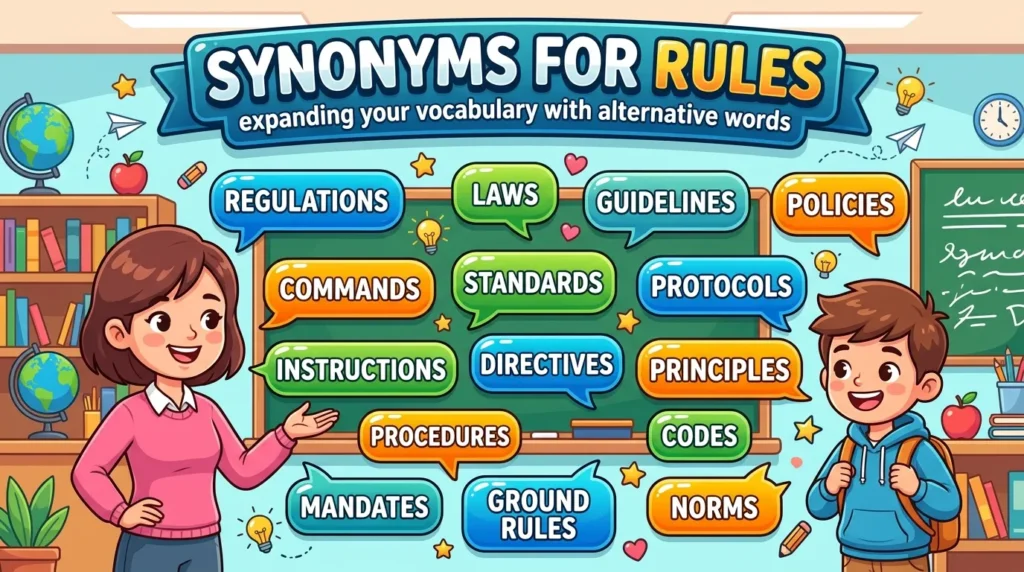
Top 5 Other Words for Rules
- Laws
- Regulations
- Guidelines
- Policies
- Instructions
Types of Synonyms for Rules
Below is a categorized list of powerful synonyms for rules.
1. Strong Synonyms for Rules
- Regulations
- Laws
- Guidelines
- Policies
- Principles
- Directives
- Commands
- Standards
- Requirements
- Protocols
2. Formal Synonyms for Rules
- Statutes
- Ordinances
- Mandates
- Codes
- Procedures
- Frameworks
- Bylaws
- Provisions
- Restrictions
- Compliance standards
3. Informal Synonyms for Rules
- Ground rules
- Dos and don’ts
- Instructions
- Orders
- Directions
- Norms
- Expectations
- Customs
- Practices
- House rules
List of 40 Synonyms for Rules with Meanings and Examples
1. Laws
Meaning
Laws are official rules made by the government.
Examples
- Traffic laws keep people safe.
- Everyone must follow the laws.
2. Regulations
Meaning
Regulations are official instructions for safety and order.
Examples
- The company follows safety regulations.
- New regulations started this year.
3. Guidelines
Meaning
Guidelines are helpful instructions to follow.
Examples
- The teacher shared writing guidelines.
- Please read the school guidelines.
4. Policies
Meaning
Policies are rules made by a school or company.
Examples
- The office changed its policies.
- Our school has strict policies.
5. Instructions
Meaning
Instructions tell people how to do something.
Examples
- Dad gave me cooking instructions.
- Read the instructions carefully.
6. Orders
Meaning
Orders are strong commands from someone in charge.
Examples
- The officer gave clear orders.
- Soldiers followed the orders quickly.
7. Commands
Meaning
Commands are direct rules people must obey.
Examples
- The dog listened to commands.
- The captain gave loud commands.
8. Standards
Meaning
Standards are levels people should meet.
Examples
- The hotel has high standards.
- Good standards improve work quality.
9. Principles
Meaning
Principles are basic ideas about right behavior.
Examples
- Honesty is one of her principles.
- Strong principles guide good people.
10. Protocols
Meaning
Protocols are official steps or procedures.
Examples
- Doctors follow health protocols.
- Safety protocols protect workers.
11. Procedures
Meaning
Procedures are steps for doing tasks correctly.
Examples
- The nurse explained the procedures.
- Follow the procedures carefully.
12. Directives
Meaning
Directives are official instructions from leaders.
Examples
- The manager shared new directives.
- Workers followed the directives immediately.
13. Codes
Meaning
Codes are systems of rules or signals.
Examples
- The school has dress codes.
- Builders follow safety codes.
14. Bylaws
Meaning
Bylaws are rules for groups or organizations.
Examples
- The club changed its bylaws.
- Members followed all bylaws.
15. Restrictions
Meaning
Restrictions are limits on actions.
Examples
- Parking restrictions start at noon.
- Travel restrictions ended yesterday.
16. Requirements
Meaning
Requirements are things people must complete.
Examples
- The job has simple requirements.
- Students met all course requirements.
17. Directions
Meaning
Directions tell someone what to do.
Examples
- Mom gave me clear directions.
- Follow the directions on the box.
18. Norms
Meaning
Norms are common ways people behave.
Examples
- Social norms change over time.
- Good manners are social norms.
19. Customs
Meaning
Customs are traditional ways people act.
Examples
- Every country has unique customs.
- Wedding customs are interesting here.
20. Practices
Meaning
Practices are usual ways of doing things.
Examples
- The company changed its practices.
- Healthy practices improve daily life.
21. Expectations
Meaning
Expectations are behaviors people want from others.
Examples
- Teachers have high expectations.
- Parents shared their expectations kindly.
22. Mandates
Meaning
Mandates are official orders from authorities.
Examples
- The city announced new mandates.
- Workers followed government mandates.
23. Statutes
Meaning
Statutes are written legal rules.
Examples
- Lawyers study many statutes.
- New statutes were approved yesterday.
24. Ordinances
Meaning
Ordinances are local government laws.
Examples
- The city changed parking ordinances.
- Noise ordinances protect neighborhoods.
25. Frameworks
Meaning
Frameworks are systems that guide actions.
Examples
- Teachers use learning frameworks.
- The project follows clear frameworks.
26. Conditions
Meaning
Conditions are rules attached to agreements.
Examples
- The ticket has special conditions.
- Read the conditions before signing.
27. Terms
Meaning
Terms are rules in agreements or contracts.
Examples
- I accepted the website terms.
- The contract terms seem fair.
28. Edicts
Meaning
Edicts are official public commands.
Examples
- The king announced new edicts.
- Citizens obeyed the royal edicts.
29. Decrees
Meaning
Decrees are formal government orders.
Examples
- The president signed new decrees.
- People discussed the decrees online.
30. Governance
Meaning
Governance means controlling and managing rules.
Examples
- Good governance helps countries grow.
- The company improved its governance.
31. Discipline
Meaning
Discipline means controlled behavior and order.
Examples
- Good discipline helps students learn.
- Team discipline improved the game.
32. Ethics
Meaning
Ethics are moral rules about right behavior.
Examples
- Doctors follow strong ethics.
- Business ethics are very important.
33. Etiquette
Meaning
Etiquette means polite social behavior.
Examples
- Table etiquette matters at dinners.
- She learned phone etiquette quickly.
34. Ground Rules
Meaning
Ground rules are basic rules for activities.
Examples
- The coach explained ground rules.
- We agreed on ground rules.
35. House Rules
Meaning
House rules are rules inside a home.
Examples
- Their house rules are strict.
- Kids must follow house rules.
36. Dos and Don’ts
Meaning
Dos and don’ts explain allowed and forbidden actions.
Examples
- The guide shared travel dos and don’ts.
- Learn the classroom dos and don’ts.
37. Compliance
Meaning
Compliance means following rules properly.
Examples
- The factory improved compliance levels.
- Compliance keeps workers safe.
38. Legalities
Meaning
Legalities are official legal requirements.
Examples
- The lawyer explained the legalities.
- We finished all legalities yesterday.
39. System
Meaning
A system is an organized set of rules.
Examples
- The school uses a grading system.
- Our system works very well.
40. Rulebook
Meaning
A rulebook is a book of rules.
Examples
- The referee checked the rulebook.
- Every player received a rulebook.
When to Use Each Synonym
Understanding the difference between these synonyms is very important because each word fits different situations.
| Synonym | Best Use |
| Laws | Government or legal context |
| Regulations | Official systems and industries |
| Guidelines | Advice or flexible instructions |
| Policies | Business or school settings |
| Principles | Moral or ethical standards |
| Commands | Military or strict authority |
| Standards | Quality or performance levels |
| Protocols | Medical or technical fields |
| Customs | Cultural traditions |
| House rules | Informal personal settings |
Synonyms for Rules in Different Contexts
1. In Business
Businesses often use formal words instead of “rules.”
Common synonyms include:
- Policies
- Regulations
- Compliance standards
- Procedures
- Directives
Example:
The company introduced new workplace policies.
2. In Daily Life
In casual conversation, people usually use simpler alternatives.
Common synonyms include:
- Instructions
- Ground rules
- Expectations
- Dos and don’ts
- House rules
Example:
My parents set clear house rules.
3. In Academic Writing
Formal writing requires more professional vocabulary.
Common synonyms include:
- Principles
- Frameworks
- Protocols
- Statutes
- Regulations
Example:
Researchers followed ethical protocols during the study.
Antonyms of Rules
Antonyms are words with opposite meanings.
| Word | Meaning |
| Freedom | Ability to act freely |
| Chaos | Complete disorder |
| Disorder | Lack of organization |
| Lawlessness | Absence of laws |
| Anarchy | No governing system |
| Flexibility | Lack of strict control |
| Independence | Freedom from rules |
| Permission | Freedom to act |
| Irregularity | Absence of standards |
| Confusion | Lack of clear structure |
Common Mistakes When Using Synonyms for Rules
1. Using “laws” for casual situations
Incorrect:
My mom made new laws at home.
Correct:
My mom made new house rules.
2. Using “guidelines” as strict commands
Guidelines are usually flexible suggestions, not strict orders.
Incorrect:
Employees were punished for ignoring simple guidelines.
Correct:
Employees were punished for breaking company regulations.
3. Confusing “principles” with “rules”
Principles are beliefs or values, while rules are instructions.
Incorrect:
The school principles are written on the wall.
Correct:
The school rules are written on the wall.
4. Using “protocols” in informal situations
Protocols sound formal and technical.
Incorrect:
We have dinner protocols at home.
Correct:
We have dinner rules at home.
FAQ About Synonyms for Rules
What is another word for rules?
Another word for rules can be laws, regulations, policies, guidelines, or instructions. These words are used in schools, offices, governments, and daily conversations to explain order and proper behavior.
Why are rules synonyms important?
Rules synonyms help improve speaking and writing skills. They make essays, blogs, emails, and conversations sound more natural, professional, and less repetitive for readers and listeners.
What are formal synonyms for rules?
Formal synonyms for rules include regulations, statutes, mandates, protocols, bylaws, and directives. These words are mostly used in legal, academic, business, and government situations.
Are guidelines and rules the same?
Guidelines are usually softer suggestions, while rules are stricter instructions. People may follow guidelines freely, but rules are often required and must be obeyed carefully.
How can students learn rules synonyms easily?
Students can learn rules synonyms by reading books, writing example sentences, practicing daily conversations, and using these words in school essays and homework activities regularly.
Conclusion
Learning synonyms for rules can make your English stronger and more interesting. Words like laws, guidelines, policies, regulations, commands, and standards help writers avoid repeating the same word many times. Try using another word for rules whenever you write or speak English. Practice these words daily in messages, homework, and conversations with friends. Small vocabulary changes can make your communication sound smarter, clearer, and more professional over time.

I am the founder and author of SynonymType.com. I am passionate about English vocabulary and help readers discover accurate synonyms with clear meanings and simple explanations. My goal is to make learning new words easy, practical, and accessible for everyone.